CardBoom vs Collectr ↗
Compare CardBoom and Collectr for card scanning, collection tracking, condition checks, price context and exports. A dated, source-linked comparison for TCG collectors.
 Get the app
CardBoom’s TCG collection tracker keeps card identity, quantity and recorded purchase details together. Follow available estimated values, recognize missing-price gaps and choose which cards to share through your collector showcase.
Example app collection shown · Market estimates and purchase costs are different values
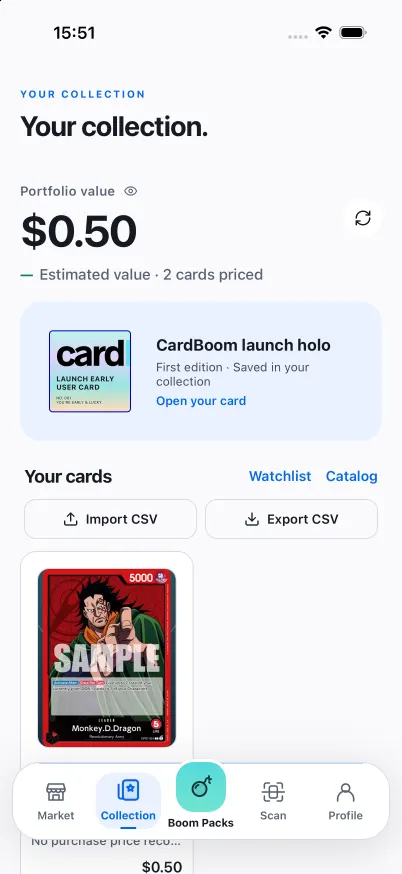
A useful inventory tells you which printing you own and how many physical copies it represents. Record the game, set, collector number, language, finish and condition wherever those details are available. A personal note or clear photo can help when a catalog entry is incomplete.
Save what you paid when you know it. Purchase cost is your record of a transaction; an estimated market value is a changing reference. Keeping them separate allows a more meaningful view of your collection than replacing one with the other.
CardBoom uses matching available estimates to value supported holdings. Quantity matters: a priced copy contributes its estimate for each recorded copy. A raw-card quote does not automatically value a different grade or worn condition.
Some entries have no reliable matching price, and some estimates may be cached rather than current. Check the value’s context and the number of priced cards. An unpriced card remains part of your inventory even when it cannot contribute a trustworthy number to the total.
See how price context worksPrice history is useful when its observations belong to the same printing, finish, currency and condition reference. Combining different sources into a smooth line can make a chart look more complete while hiding meaningful differences.
CardBoom’s collection view separates the current estimate from available history. A missing purchase cost cannot establish a profit or loss, and a lack of historical observations does not establish that a card’s price has been flat. Use the information available rather than reading a blank as a financial result.
Practical answers for the card in your hand.
Yes, record the quantity of the matching collection entry. Keep printing, language, finish and condition distinctions clear. A pair of visually similar cards should not be merged simply because they share a name.
Some entries may lack a matching price for their exact printing or condition. Check the priced-card count and any cached-estimate information. The inventory can contain a card even when its value is unavailable; a missing quote does not mean the card is worth zero.
A purchase price is useful when you want to compare cost and estimated value, but you may not know it for every gift, trade or old purchase. Preserve the ownership record and leave unknown costs unset rather than recording a guessed zero as a real acquisition cost.
Review the account’s public-showcase settings and selected cards before sharing your profile. Use the public view to confirm what another collector can see. A showcase should be a deliberate selection, not an assumption that all private collection details are public.
The collection image is a development-app example with two recorded copies and a cached estimate. It is not a claim about a reader’s collection, a live sale or an expected return. Price coverage and history vary by printing.